
15 Years Forward: When Policy Meets Purpose | Michele Strasz
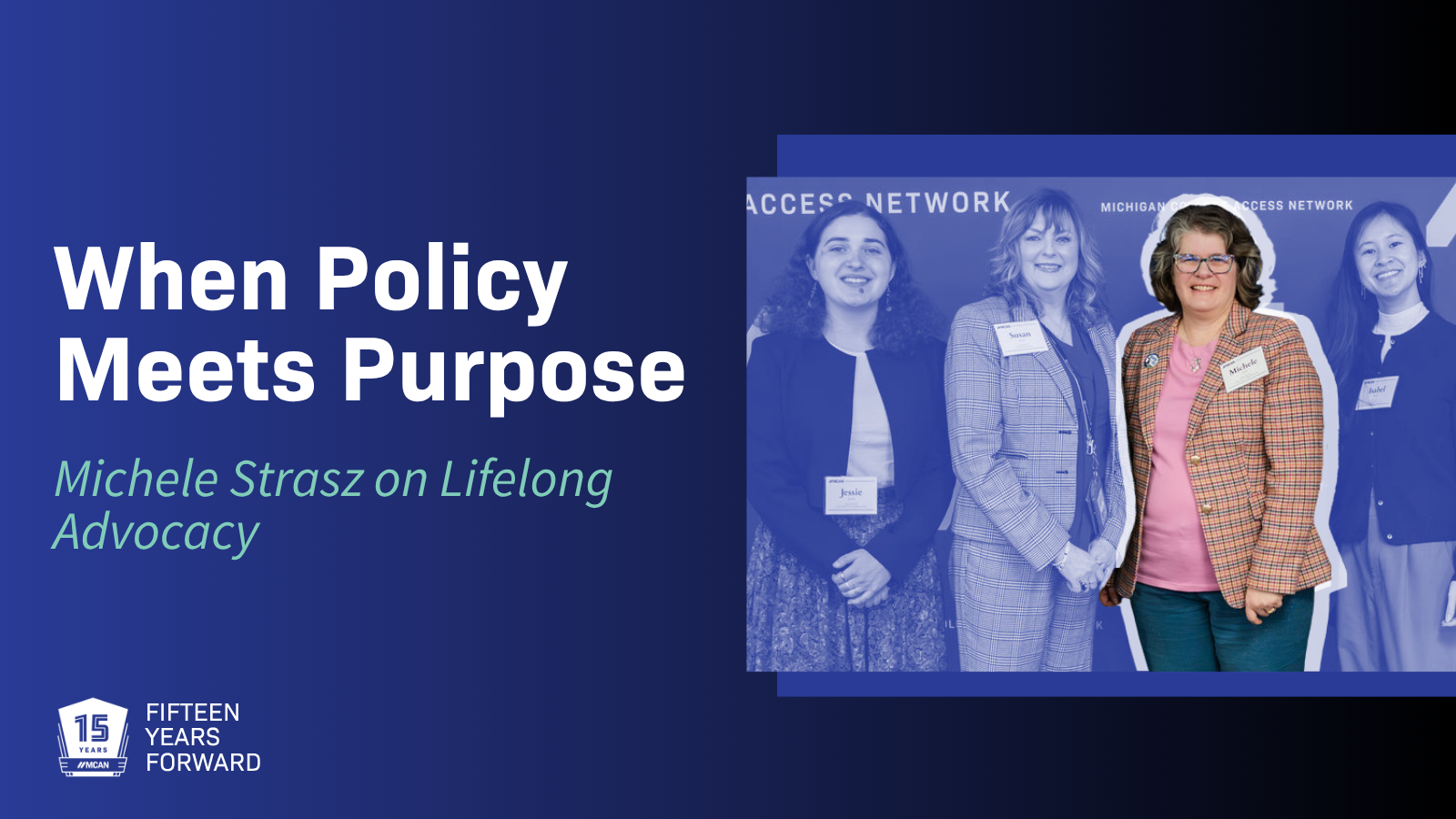
Michele Strasz has attended every single MCAN advocacy event. All nine of them. That’s dedication.
As director of the Capital Area College Access Network (CapCAN) and a leader at United Way South Central Michigan, Michele has spent her career at the intersection of community impact and public policy. She is, in every sense, the kind of partner that makes this work possible and the kind of advocate that makes it matter.
As we reflect on 15 years of postsecondary progress through the lens of policy, Michele's story is exactly the one we want to tell.
Lifelong Advocacy Evolves into Her Calling: A Kismet Moment
Michele didn't arrive at college access work by accident. She arrived by listening to her community, to colleagues, and to a calling she'd been answering for years without quite knowing its name.
"I have been a lifelong child advocate working in state-level public policy advocacy," she said. "I guess I was doing collective impact before that was the name for it."
Her path to MCAN began with a youth empowerment conference, a conversation with MCAN's then Executive Director Brandy Johnson, and a colleague who pointed her toward CapCAN in 2014. She described it simply: "It was kismet." Eleven years later, she's still here — because the work demands it, and because she understands exactly what's at stake.
Michele doesn't talk about college access as an aspiration. She talks about it as infrastructure. At United Way, they use the framework of ALICE — people who are Asset Limited, Income Constrained, and Employed — as a vivid reminder that employment alone isn't enough.
"Folks that earn postsecondary degrees and credentials are more likely to live above the federal poverty level and ALICE threshold because they tend to work in high-demand and high-wage jobs that can sustain a family."
The case she makes isn't abstract. It's a family's financial stability, a region's economic competitiveness. The difference between getting by and getting ahead.
Building a Coalition That Legislators Can't Ignore
Ask Michele what's changed since MCAN’s first Advocacy Day, and she'll tell you: the room got bigger, and the coalition got bolder.
"My first recollection was that most of the folks who attended Advocacy Day were specifically connected to MCAN," she recalled. Over the years, that circle expanded to include higher education institutions, financial aid experts, scholarship partners, and workforce allies — all unified around college access. And that unity, Michele will tell you, is the strategy.
"It is important to show our elected officials that our coalition represents entities that might not always agree on other issues, but they completely agree on the economic, social, and educational return on investment of postsecondary education. We are modeling nonpartisan coalition building, the art of compromise, and making decisions that are in the best interest of students, our industries, and the taxpayers."
When a room full of people who don't always agree shows up unified, legislators notice. Over 15 years, MCAN has turned that notice into action, forging bipartisan relationships and advocating successfully for programs that have fundamentally changed what's possible for Michigan students. Programs like the Michigan Achievement Scholarship, Michigan Reconnect, and Community College Guarantee have been, in Michele's words, "game changers." The proof shows up at FAFSA nights.
"When I go out into the community and help families with FAFSA, I always ask, 'Are you aware that your student is probably eligible for free money for college?' Every hand goes up. This was not the case when I started in 2014."
Even through the disruption of COVID, the Capital region has seen steady gains. "If we had not had MCAN and CapCAN, I know in my heart, and based upon the data, that we would have lost more ground."
The Work That's Still Ahead
Michele is proud of the progress. She's also clear-eyed about what's unfinished.
This year, CapCAN used Advocacy Day, now renamed College Attainment Advocacy Day, to spotlight a gap hiding inside a win: Michigan's Community College Guarantee, despite its promise, created unintended disparities in the tri-county region. Not all students are considered in-district at Lansing Community College — a technicality with real consequences for real families. "We hope to be part of a bipartisan solution to continue to invest in early credit options," she said.
Looking further ahead, Michele is focused on protecting federal programs like GEAR UP and TRIO, expanding Career and Technical Education and dual enrollment so students can explore pathways before committing to a degree, and supporting adult learners returning to education with the financial aid, childcare, and transportation they need to finish. "Students who have the chance to explore career pathways early on are more likely to complete the steps to postsecondary education," she explained. "They are also more likely to complete a degree or credential because they know their why and the how."
Above all, she's thinking about leadership. "Our progress in Michigan is dependent upon choosing leaders who will continue to build on the investments of the past 15 years."
Fifteen Years Forward
College Attainment Advocacy Day is, Michele says, "one of my favorite days of the year." That joy — after nine of them, after years of legislative meetings and coalition calls and FAFSA tables in community centers — says something important. It says this work is worth showing up for, year after year, because the students it serves are worth fighting for.
Fifteen years ago, MCAN planted a stake in Michigan's future. Today, the coalition is larger, the policy wins are real, and the urgency is undiminished. College still matters. The progress proves it. And partners like Michele Strasz remind us why we keep going.
MCAN is celebrating 15 years of work in advancing college access. Work that has been instrumental in setting a foundation toward Michigan’s Sixty by 30 goal — ensuring 60% of Michigan residents hold a postsecondary credential by 2030.